


How to Read Nootropic Research: A Beginner’s Guide to Evaluating the Evidence
You’ve seen the claims. L-theanine sharpens focus. Bacopa boosts memory. Lion’s mane rebuilds neurons.
The supplement industry pumps out promises backed by “clinical studies,” and suddenly everyone’s a neuroscientist on Reddit. But here’s the uncomfortable truth: most people who cite research can’t actually read it.
They skim abstracts, mistake mouse studies for human proof, and cherry-pick findings that confirm what they already bought. Learning how to read nootropic research isn’t about becoming a scientist—it’s about not getting played by marketing departments with PhDs on payroll.
The nootropic world runs on hope and hype in equal measure. Companies know that slapping “clinically proven” on a label moves product, even when the “proof” comes from a study of twelve college students funded by the ingredient manufacturer.
Your suspicions about inflated claims? Justified.
Your frustration with contradictory findings? Understandable.
The research landscape is messy, biased, and designed to confuse anyone without a graduate degree.
But you don’t need that degree. You just need the right questions and a healthy dose of skepticism.
Key Takeaways
- Not all studies carry equal weight: Randomized controlled trials and meta-analyses provide the strongest evidence, while animal and cell studies only generate hypotheses
- Six critical questions separate good research from marketing fluff: randomization, blinding, sample size, population type, outcome measures, and funding sources
- Industry funding creates systematic bias: Studies funded by ingredient manufacturers show significantly more positive results than independent research
- Free databases like PubMed and Examine.com give you direct access to peer-reviewed research without paywalls or marketing spin
- Reading research is a skill that protects your wallet and your health: Understanding evidence hierarchies helps you make informed decisions about cognitive enhancement
Why Most People Read Research Wrong
The abstract sits at the top of every research paper like a movie trailer—short, punchy, designed to grab attention. Most readers stop there. They see “significant improvement in working memory” and assume the case is closed.
But abstracts compress complex findings into digestible bites, often glossing over crucial limitations buried in the methods section. That “significant” improvement might be a 3% change on a single cognitive test, measured in rats, after doses equivalent to eating a kilogram of the supplement daily.
Animal studies flood the nootropic literature because they’re cheaper and faster than human trials. Mice respond beautifully to compounds that do absolutely nothing in humans. Their metabolism runs differently. Their blood-brain barriers work differently. Their brains are, unsurprisingly, not human brains.
Yet supplement marketers love mouse studies because they can claim “research shows” without the messy complications of actual human evidence. The leap from rodent to human is vast, expensive, and frequently disappointing.
Study quality varies wildly. A rigorous trial with 200 participants, proper randomization, and validated cognitive tests carries infinitely more weight than a pilot study of fifteen people using self-reported “mental clarity” scores.
But both get labeled “clinical research” on product pages. Without understanding methodological quality, every study looks equally credible. They’re not.
Then there’s confirmation bias, the silent killer of critical thinking. When you’ve already spent $60 on a nootropic stack, your brain desperately wants the research to support that decision.
You’ll unconsciously seek out positive studies, dismiss negative findings as flawed, and interpret ambiguous results as victories. This isn’t a character flaw—it’s human nature. Learning how to read nootropic research means recognizing this bias and compensating for it.
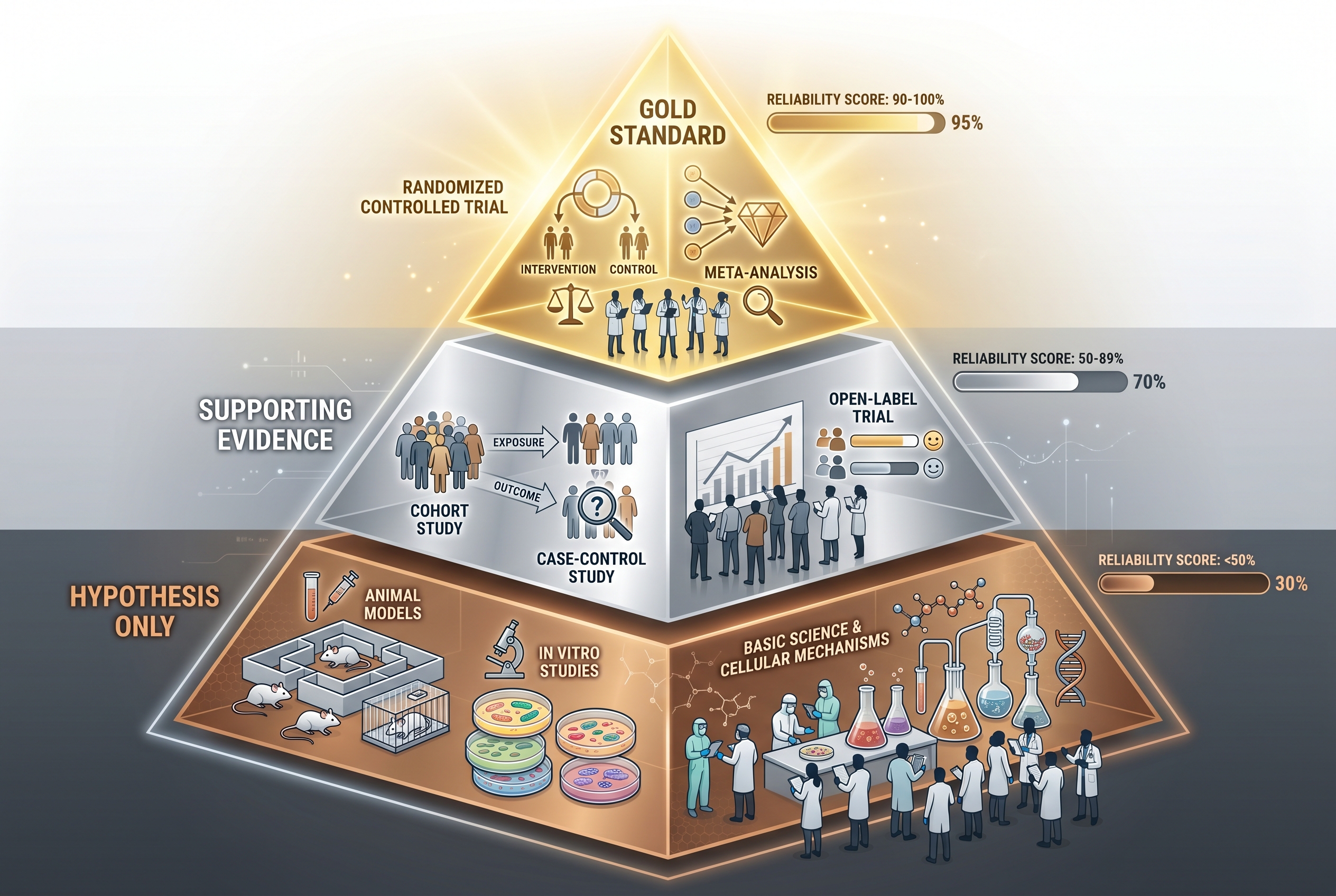
The Evidence Hierarchy — Not All Studies Are Equal
Research exists in tiers. Understanding this hierarchy transforms how you evaluate claims and separates genuine evidence from scientific window dressing.
Tier 1 — The Gold Standard
Randomized Controlled Trials (RCTs) sit at the top of the evidence pyramid. These studies randomly assign participants to either receive the nootropic or a placebo, then compare outcomes between groups.
Randomization eliminates selection bias—the tendency for healthier, more motivated people to end up in treatment groups. When done properly, RCTs isolate the compound’s actual effect from everything else.
Double-blind placebo-controlled designs take this further. Neither the participants nor the researchers know who’s getting the real compound until the study ends.
This eliminates the placebo effect (people feeling smarter because they expect to) and researcher bias (scientists unconsciously treating groups differently). When someone reports “feeling more focused” on a nootropic, a double-blind RCT tells you whether that’s the compound or the power of expectation.
Meta-analyses and systematic reviews synthesize multiple RCTs into a single analysis. Instead of relying on one study’s findings, these reviews combine data from dozens of trials to identify consistent patterns.
They’re the closest thing to definitive answers in medical research. A meta-analysis showing no cognitive benefit from a popular nootropic should end the conversation, but it rarely does—because marketing doesn’t care about meta-analyses.
Tier 2 — Useful Supporting Evidence
Observational and epidemiological studies track populations over time, looking for correlations between behaviors and outcomes. These studies might find that people who consume more omega-3s have better cognitive function in old age.
But correlation isn’t causation. Maybe omega-3 consumption correlates with higher income, better healthcare, and more education—all factors that independently protect cognitive function. Observational studies generate interesting hypotheses but can’t prove causation.
Open-label trials tell participants exactly what they’re taking. These studies are cheaper and easier to run, but they’re plagued by placebo effects.
When everyone knows they’re taking the “brain-boosting” supplement, expectation drives a significant portion of any reported benefit. Open-label trials can provide preliminary safety data and help researchers design better studies, but they shouldn’t drive purchasing decisions.
Tier 3 — Hypothesis-Generating Only
Animal studies belong in the laboratory, not on supplement labels. Yes, that compound increased neurogenesis in mice. Mice also eat their own feces and have lifespans of two years.
The physiological differences between species mean that animal research generates hypotheses for human testing—nothing more. When a company’s “research” consists entirely of rodent studies, that’s a red flag the size of a laboratory rat.
Cell culture studies take this another step further from human relevance. Researchers expose neurons in a petri dish to a compound and measure effects.
These studies reveal mechanisms and possibilities, but a neuron in a dish doesn’t have a blood-brain barrier, a liver metabolizing the compound, or the complex interactions of a living system. Cell culture research is fascinating science and terrible marketing evidence.
Case reports and anecdotes sit at the bottom of the evidence hierarchy. “I took this nootropic and aced my exam” tells you nothing about causation, reproducibility, or whether the same effect occurs in anyone else.
Anecdotes are powerful for generating hypotheses and understanding subjective experiences, but they’re not evidence of efficacy.
The Six Questions to Ask About Any Study
When evaluating nootropic research, these six questions cut through the noise faster than any amount of scientific jargon.
1. Was it randomized and controlled? If participants weren’t randomly assigned to treatment and control groups, the study can’t separate the compound’s effects from selection bias. Non-randomized studies are essentially sophisticated anecdotes.
2. Was it double-blinded? If researchers or participants knew who was getting the real compound, placebo effects and expectation bias contaminate the results. Single-blind (only participants don’t know) is better than nothing, but double-blind is the standard.
3. What was the sample size? Studies with fewer than 20 participants per group are underpowered—they lack the statistical strength to detect real effects or rule out chance findings. Larger samples provide more reliable results. Be especially skeptical of pilot studies with tiny sample sizes being marketed as definitive proof.
4. What was the population? A study showing cognitive benefits in elderly patients with mild cognitive impairment tells you nothing about effects in healthy 30-year-olds. Age, health status, and baseline cognitive function dramatically affect how people respond to nootropics. Always check whether the study population matches your situation.
5. What outcome measures were used? Validated cognitive tests like the Stroop test, N-back task, or Trail Making Test provide objective measurements. Self-reported “mental clarity” or “focus” are subjective and easily influenced by expectation. The more objective and validated the outcome measure, the more trustworthy the results.
6. Who funded it? This question deserves its own section.
The Industry Funding Problem
Follow the money, and you’ll understand why nootropic research often contradicts itself. Industry-funded studies show systematically more positive results than independent research—a pattern documented across pharmaceuticals, supplements, and medical devices. This isn’t necessarily fraud. It’s subtler.
Companies fund studies on their own ingredients, which makes business sense. But financial conflicts of interest create pressure—conscious or unconscious—to design studies that favor positive outcomes.
Researchers might choose outcome measures where the compound performs best, analyze data in ways that highlight benefits, or simply decline to publish negative findings. Publication bias means that failed studies disappear into file drawers while successful ones get published and cited on product pages.
How to check funding sources: Scroll to the end of any research paper. The “Funding” or “Conflicts of Interest” section reveals who paid for the study. Look for phrases like “This research was supported by [Ingredient Company]” or “Author X is employed by [Supplement Manufacturer].” These disclosures are required by journals, but they’re easy to miss if you’re not looking.
Some branded ingredients have extensive research portfolios funded entirely by their manufacturers. TeaCrine (theacrine) research, for example, comes predominantly from studies funded or conducted by Compound Solutions, the company that holds the TeaCrine trademark.
This doesn’t automatically invalidate the findings, but it demands extra scrutiny. Independent replication by researchers without financial ties to the company would strengthen the evidence considerably.
The gold standard is independent research funded by government agencies like the National Institutes of Health or non-profit foundations without commercial interests.
These studies have no financial incentive to produce positive results. When independent research contradicts industry-funded studies, trust the independent research.

Where to Find Reliable Research
Learning how to read nootropic research requires access to actual research, not marketing summaries. These resources provide direct access to peer-reviewed literature and evidence-based analyses.
PubMed.gov is the primary database of biomedical literature, maintained by the National Library of Medicine. It’s free, comprehensive, and searchable. Type in any nootropic name plus “cognitive function” or “memory” and you’ll get a list of published studies.
Most abstracts are freely available; full papers sometimes require payment or institutional access, but abstracts alone provide enough information to evaluate study quality using the six questions above.
Examine.com offers independent, evidence-based summaries of supplement research. Their team of researchers reviews the literature on hundreds of compounds, grades the evidence quality, and provides clear summaries of what works, what doesn’t, and what remains uncertain.
They make money through subscriptions and guides, not by selling supplements, which reduces conflicts of interest. Their nootropic pages are excellent starting points for understanding the evidence landscape.
Cochrane Reviews represent the highest quality systematic reviews in healthcare. The Cochrane Collaboration is an international network of researchers who conduct rigorous meta-analyses following strict methodological standards.
Cochrane reviews on cognitive enhancement interventions provide the most reliable summaries of evidence available. They’re technical but thorough.
The Nootropics Expert and Neurohacker Collective produce quality educational content about cognitive enhancement, but both have commercial interests. The Nootropics Expert sells courses and affiliate products.
Neurohacker Collective manufactures Qualia and other nootropic formulations. Their information is generally accurate and well-researched, but view it as secondary sources with potential bias rather than independent analysis.
When researching any nootropic, start with PubMed to find primary research, cross-reference findings with Examine.com’s evidence summaries, and check whether Cochrane has reviewed the topic. This three-step process gives you a solid evidence foundation in 20-30 minutes.
🧪 Research Quality Evaluator
Answer these questions about a study to assess its evidence quality
FAQ
Q: Can I trust studies published in peer-reviewed journals?
Peer review improves quality but doesn’t guarantee accuracy. Journals vary in rigor, and peer review doesn’t catch all methodological flaws or conflicts of interest. Use peer review as a baseline filter, then apply the six critical questions to evaluate individual studies.
Q: How many studies do I need to see before trusting a nootropic’s effectiveness?
Look for multiple independent RCTs with consistent findings, ideally synthesized in a systematic review or meta-analysis. A single positive study—especially if industry-funded—isn’t sufficient. Three or more independent RCTs showing similar effects provide reasonable confidence.
Q: What if animal studies are the only research available for a nootropic?
Animal-only evidence means the compound is unproven in humans. It might work, but you’re essentially participating in an uncontrolled experiment on yourself. Proceed with extreme caution, start with minimal doses, and recognize you’re taking a significant evidence gamble.
Q: Are systematic reviews always better than individual studies?
Generally yes, but quality matters. A systematic review that includes low-quality studies or has methodological flaws can be misleading. Check the review’s methodology, inclusion criteria, and whether it assessed study quality. Cochrane reviews set the gold standard.
Q: How do I know if a cognitive test used in research is validated?
Validated tests appear repeatedly across multiple studies and have established reliability and sensitivity. Common validated tests include the Stroop test, Trail Making Test, N-back task, and various memory assessments. Be skeptical of proprietary or custom tests created specifically for one study.
Q: Should I completely ignore industry-funded research?
No, but view it with healthy skepticism and look for independent replication. Industry funding doesn’t automatically invalidate findings, but it creates bias risk. When industry-funded and independent research agree, confidence increases. When they conflict, trust independent research.
Bottom Line
Learning how to read nootropic research isn’t about memorizing scientific terminology or earning a biology degree. It’s about asking the right questions, understanding evidence hierarchies, and recognizing when marketing masquerades as science.
The six critical questions—randomization, blinding, sample size, population, outcome measures, and funding—cut through promotional noise faster than any amount of abstract-skimming.
The evidence hierarchy matters. Randomized controlled trials and meta-analyses provide actionable evidence. Animal studies and cell culture research generate hypotheses, not purchasing decisions.
Industry funding creates systematic bias that demands extra scrutiny and independent verification. These aren’t cynical assumptions—they’re documented patterns across medical research.
Start with PubMed for primary research, cross-reference with Examine.com for evidence summaries, and check for Cochrane reviews when available. This three-step process takes 20 minutes and provides more reliable information than hours of forum-browsing or influencer-watching.
The research is freely available. The tools are accessible. The only barrier is the willingness to look beyond marketing claims.
Your next step: Pick one nootropic you’re currently taking or considering. Search PubMed for “[compound name] cognitive function.”
Read three abstracts. Apply the six questions. Check the funding sources. See what you discover.
That 15-minute exercise will change how you evaluate every supplement claim you encounter. The research was always there. Now you know how to read it.


