


Can Nootropics Make You Smarter? The Science Behind the Claims
You’ve already done the work. You’ve read the books, logged the hours, built the skills. Now you’re looking for an edge—something to sharpen what’s already there, to make the effort count more. The question isn’t whether you’re capable; it’s whether nootropics can help you access more of that capability when it matters most. The answer is more nuanced than the marketing suggests, but also more interesting than the skeptics admit.
The conversation around whether can nootropics make you smarter has become cluttered with both wild promises and dismissive cynicism. Neither extreme serves anyone well.
The truth sits in the middle: nootropics won’t transform you into a genius, but specific compounds can produce measurable improvements in specific cognitive domains—improvements that, while modest in percentage terms, can feel significant in real-world application.
Key Takeaways
- “Smarter” is too vague: Nootropics affect specific cognitive domains (memory, processing speed, focus) rather than general intelligence
- Effect sizes are real but modest: Expect 10-20% improvements in targeted areas, not dramatic IQ jumps
- Optimization, not creation: Nootropics tune existing cognitive capacity; they don’t add new hardware
- Context matters enormously: Effects are strongest in people with deficiencies, fatigue, or age-related decline
- Compound gains add up: Multiple small improvements across different domains can create meaningful real-world advantages
What Does ‘Smarter’ Actually Mean?
The word “smarter” collapses too many different things into one bucket. Intelligence isn’t a single dial you turn up. It’s more like an orchestra—different instruments playing different parts, and the quality of the performance depends on which instruments you’re measuring and when.
IQ tests measure one kind of intelligence: the ability to recognize patterns, solve novel problems, and think abstractly. Psychologists call this the g factor or general intelligence. But practical intelligence—the kind that helps you navigate complex social situations, learn new skills quickly, or make good decisions under pressure—involves different cognitive systems entirely.
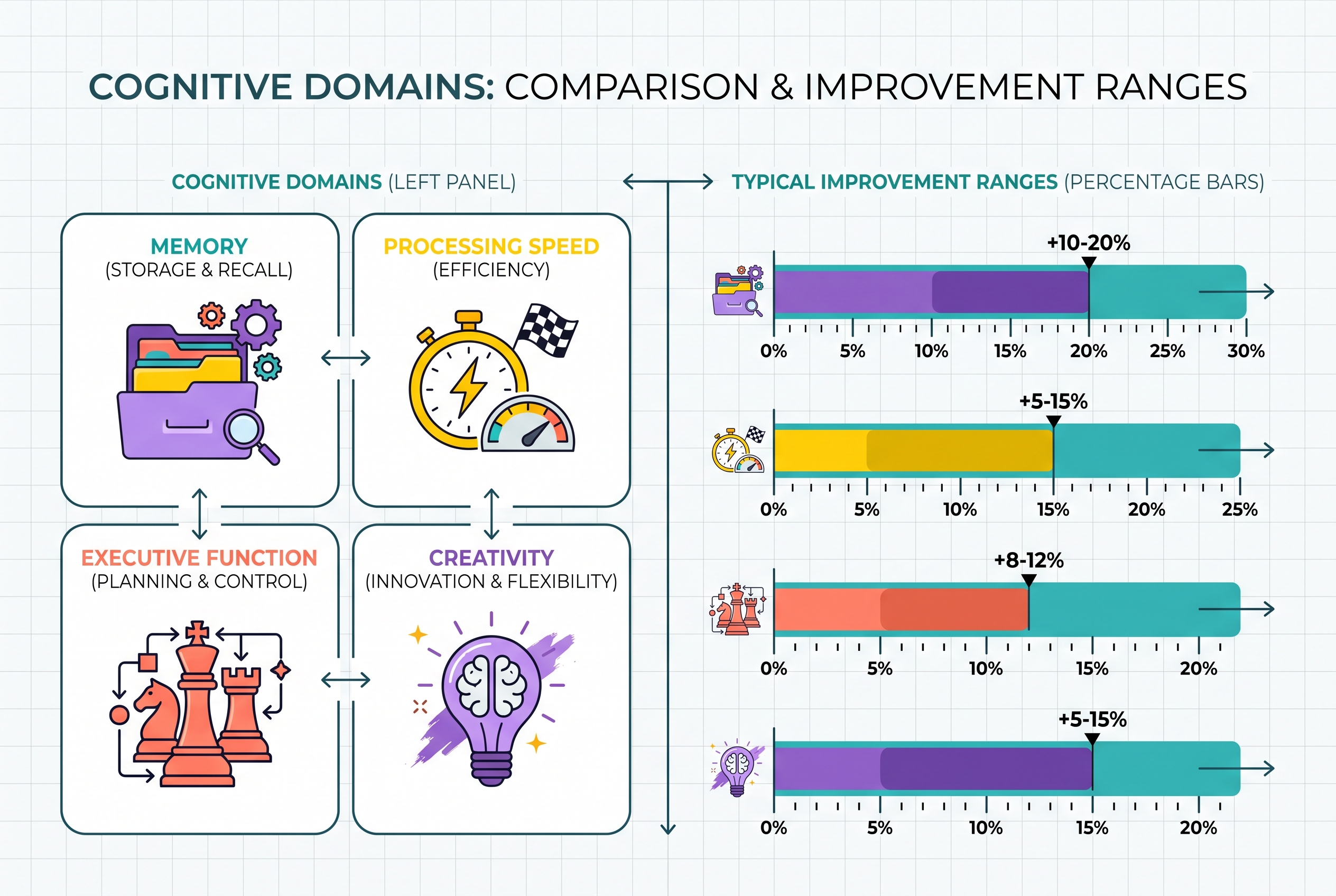
When researchers ask whether can nootropics make you smarter, they’re really asking whether these compounds can improve performance in specific cognitive domains:
- Memory: Both short-term working memory (holding information in mind) and long-term recall
- Processing speed: How quickly you can take in information and respond
- Executive function: Planning, decision-making, impulse control, task-switching
- Creativity: Divergent thinking, novel connections, problem-solving flexibility
Here’s the critical point: a compound might improve working memory by 15% while having zero effect on processing speed or creativity. That’s still valuable—working memory capacity predicts performance across dozens of real-world tasks—but it’s not the same as “getting smarter” in the broad sense most people imagine.
The measurement problem matters too. Standardized cognitive tests capture some aspects of mental performance well and others poorly. A 10% improvement on a verbal memory test might translate to remembering three more items from a list of twenty. In a classroom or meeting, that could mean the difference between following a complex argument and losing the thread. But it won’t show up as a higher IQ score.
What the Evidence Actually Shows
The Small But Real Effect Sizes
The research literature on nootropics contains thousands of studies, many of them small, some of them contradictory, and a few of them genuinely rigorous. When you look at the highest-quality randomized controlled trials—the gold standard for medical evidence—a pattern emerges.
Typical cognitive improvements range from 10-20% on standardized tests. That’s the honest number. Not 50%, not 100%, not “limitless.” Ten to twenty percent.
To put that in context: if you normally score 70 out of 100 on a working memory test, a nootropic might help you score 77 or 80. If you can hold five pieces of information in mind simultaneously, you might manage six. If you need 45 minutes to complete a cognitively demanding task, you might finish in 40.
These improvements are statistically significant—meaning they’re unlikely to be due to chance—but the practical significance depends entirely on your situation. For a student taking a high-stakes exam, a 15% improvement in recall could change outcomes. For someone doing routine work that doesn’t tax cognitive capacity, the same improvement might be imperceptible.
The effects are most reliable in three populations:
- Fatigued individuals: Caffeine and L-theanine combinations consistently improve attention and processing speed in sleep-deprived people
- Older adults: Compounds like DHA, phosphatidylserine, and certain B vitamins show stronger effects in people experiencing age-related cognitive decline
- People with deficiencies: Creatine improves cognitive performance in vegetarians (who get little dietary creatine); B12 helps people with B12 deficiency; iron supplementation helps those with low iron
If you’re well-rested, well-nourished, young, and healthy, many nootropics will do very little. You’re already operating near your biological ceiling.
The Optimizing vs. Creating Distinction
Think of cognitive capacity like an engine. Nootropics can tune the engine—adjust the timing, clean the fuel injectors, optimize the air-fuel mixture. They can’t add cylinders or increase displacement. The hardware you have is the hardware you’re working with.
This is why can nootropics make you smarter is the wrong question. The right question is: “Can nootropics help me access more of the cognitive capacity I already have?”
The answer to that question is often yes.
Your brain already contains roughly 86 billion neurons and 100 trillion synaptic connections. The limiting factors on cognitive performance usually aren’t the number of neurons—it’s things like:
- Neurotransmitter availability: Not enough acetylcholine, dopamine, or serotonin at the right times
- Energy metabolism: Insufficient ATP production in neurons
- Inflammation: Chronic low-grade inflammation that impairs neural signaling
- Blood flow: Inadequate oxygen and nutrient delivery to brain tissue
- Oxidative stress: Free radical damage to cellular machinery
Nootropics work by addressing these limiting factors. Alpha-GPC provides choline for acetylcholine synthesis. Creatine improves cellular energy production. Curcumin reduces neuroinflammation. Ginkgo biloba increases cerebral blood flow. Antioxidants like vitamin E reduce oxidative damage.
None of these interventions add new cognitive capacity. They remove obstacles to using the capacity that’s already there.
Here’s the uncomfortable truth: adequate sleep, regular exercise, and good nutrition are more powerful cognitive enhancers than any nootropic. Sleep deprivation can reduce cognitive performance by 30-40%. Exercise increases BDNF (brain-derived neurotrophic factor), promotes neurogenesis, and improves executive function. A diet rich in omega-3s, antioxidants, and B vitamins provides the raw materials for optimal brain function.
Nootropics work best as a supplement to these fundamentals, not a replacement for them.
The IQ Question — Can You Raise Your IQ?
IQ tests attempt to measure g, or general intelligence—the common factor that underlies performance across diverse cognitive tasks. The question of whether you can increase your IQ through any intervention, including nootropics, is one of the most contentious in psychology.
What IQ measures: Pattern recognition, logical reasoning, spatial visualization, and processing speed. It’s designed to capture fluid intelligence—the ability to solve novel problems—rather than crystallized intelligence, which is accumulated knowledge and skills.
The distinction matters because crystallized intelligence is much easier to improve than fluid intelligence. You can learn more vocabulary, acquire more facts, develop more expertise. That’s crystallized intelligence, and it increases throughout life with education and experience.
Fluid intelligence—raw problem-solving ability—is more stubborn. It peaks in early adulthood and gradually declines. Decades of research on “brain training” programs have shown that while you can get better at specific tasks through practice, those improvements rarely transfer to other domains. Getting better at Sudoku makes you better at Sudoku, not better at math or logic in general.
So can nootropics raise your IQ? The honest answer is: probably not in any meaningful, lasting way.
There’s one notable exception: a 2003 study by Rae and colleagues found that creatine supplementation improved working memory and intelligence test scores in vegetarians. The effect size was modest but real—about 0.4 standard deviations, which translates to roughly 6 IQ points. The researchers hypothesized that vegetarians have lower baseline creatine levels (since creatine comes primarily from meat), and supplementation brought them up to optimal levels.
This fits the pattern: nootropics work best when they’re correcting a deficiency or suboptimal state. They bring you up to your potential, not beyond it.

The Specific Things Nootropics Can Improve
Rather than asking whether can nootropics make you smarter in general, it’s more useful to ask what specific cognitive functions they can enhance. The evidence is strongest for these domains:
Working Memory Capacity 💭
Working memory—the ability to hold and manipulate information in your mind—is one of the most consistently improved domains. Compounds with evidence include:
- Bacopa Monnieri: Multiple studies show 10-15% improvements in working memory after 8-12 weeks
- Alpha-GPC: Increases acetylcholine availability, supporting working memory processes
- Caffeine + L-theanine: Improves working memory performance during cognitively demanding tasks
Processing Speed ⚡
How quickly you can take in information, make decisions, and respond:
- Caffeine: Reduces reaction time by 10-15% in most people
- DHA (omega-3): Long-term supplementation (6+ months) shows modest improvements in processing speed
- Vitamin B12: In people with deficiency or suboptimal levels, B12 supplementation improves processing speed
Verbal Memory 📚
The ability to remember words, names, and language-based information:
- Bacopa Monnieri: This is where Bacopa shines brightest—consistent 15-20% improvements in verbal recall
- Phosphatidylserine: Some evidence for improved verbal memory in older adults
- Ginkgo biloba: Mixed evidence, but some studies show modest improvements in verbal memory
Pattern Recognition 🧩
The ability to identify relationships and solve novel problems:
- Racetams (piracetam, aniracetam): Limited but intriguing evidence for improved pattern recognition
- Creatine: The vegetarian study showed improvements in Raven’s Progressive Matrices, a pattern recognition test
The Honest Bottom Line
So, can nootropics make you smarter? Here’s what a realistic outcome looks like:
You won’t suddenly understand quantum physics if you struggled with algebra. You won’t write a novel if you’ve never written a paragraph. You won’t become a chess grandmaster if you barely know how the pieces move.
But you might:
- Remember 15-20% more of what you read or hear
- Process information 10-15% faster when you’re fatigued
- Maintain focus for an extra 20-30 minutes during cognitively demanding work
- Recall names and details more reliably in conversations
- Experience less mental fog during afternoon slumps
These improvements are genuinely valuable. A 20% improvement in memory retention could mean the difference between passing and failing an exam, between remembering a client’s preferences and forgetting them, between following a complex technical discussion and getting lost.
The stack approach—combining multiple nootropics that work through different mechanisms—can produce compound benefits. Caffeine improves alertness and processing speed. L-theanine smooths out caffeine’s jittery edge and improves attention. Bacopa enhances memory consolidation. Alpha-GPC supports acetylcholine synthesis. Creatine improves cellular energy production.
Each compound contributes a small improvement in a specific domain. Together, they can create a noticeable enhancement in overall cognitive performance—not because they’re making you smarter in some fundamental way, but because they’re helping you access more of the capacity you already have, more reliably, when you need it most.
The key is managing expectations. Nootropics are tools, not magic. They work best when combined with the fundamentals: adequate sleep, regular exercise, good nutrition, and deliberate practice. They can give you an edge, but they can’t do the work for you.
🧠 Nootropic Effect Calculator
Calculate realistic cognitive improvements based on research
FAQ
Q: How long does it take for nootropics to work?
It depends on the compound. Caffeine works within 30 minutes. Bacopa Monnieri requires 8-12 weeks of daily use to show effects. Creatine takes 4-6 weeks. Fast-acting nootropics affect neurotransmitter levels immediately; slower ones work by gradually changing brain structure or metabolism.
Q: Can you build tolerance to nootropics?
Yes, to some compounds. Caffeine tolerance develops within 1-2 weeks of daily use. Racetams show less tolerance. Bacopa's effects appear to be sustained without tolerance. Cycling (taking breaks) can help maintain effectiveness for compounds prone to tolerance.
Q: Are nootropics safe for long-term use?
Most well-studied nootropics (caffeine, omega-3s, B vitamins, Bacopa, creatine) have excellent long-term safety profiles when used at recommended doses. Newer or less-studied compounds carry more uncertainty. Always research specific compounds and consult healthcare providers.
Q: Will nootropics help if I'm already performing well?
Probably less than if you're fatigued, deficient, or experiencing decline. The "ceiling effect" means people already operating near their cognitive peak see smaller gains. Nootropics work best when there's room for optimization.
Q: Can you combine multiple nootropics safely?
Often yes, but it requires research. Some combinations are synergistic (caffeine + L-theanine). Others may interact negatively or be redundant. Start with single compounds, understand their effects, then add others carefully. Avoid excessive stimulant stacking.
Q: Do nootropics work better for certain types of intelligence?
Yes. Memory-focused nootropics (Bacopa, Alpha-GPC) improve recall and retention. Stimulants (caffeine) enhance processing speed and attention. Few if any nootropics reliably improve creativity or emotional intelligence. Match the compound to the cognitive domain you want to enhance.
Wrapping Up
The question of whether can nootropics make you smarter doesn't have a simple yes or no answer. They won't raise your IQ by 20 points or turn you into a genius. But they can produce modest, measurable improvements in specific cognitive domains—improvements that, while small in percentage terms, can translate to meaningful real-world advantages.
The key is approaching nootropics with realistic expectations and a clear understanding of what they can and cannot do. They optimize existing capacity; they don't create new capacity. They work best when you're already doing the fundamentals right: sleeping enough, eating well, exercising regularly, and practicing the skills you want to improve.
Actionable next steps:
Identify your specific cognitive goals: Better memory? Faster processing? Improved focus? Different nootropics target different domains.
Start with the fundamentals: Before adding supplements, optimize sleep, nutrition, and exercise. These provide bigger gains than any nootropic.
Research specific compounds: Look for high-quality studies on the nootropics you're considering. Understand typical effect sizes and time frames.
Start with single compounds: Test one nootropic at a time so you can assess its individual effects before stacking.
Track your results: Use objective measures (memory tests, timed tasks) rather than subjective feelings to evaluate effectiveness.
Be patient: Many nootropics require weeks or months of consistent use to show effects. Quick fixes are rare.
The science behind nootropics is evolving, but the current evidence suggests they're neither miracle drugs nor snake oil. They're tools—modest but real tools—for people who want to access more of their cognitive potential.
Used wisely, they can provide an edge. Just remember: the edge is small, and it works best when everything else is already in place.


